

КАМ’ЯНСЬКИЙ ПРОФЕСІЙНИЙ ЛІЦЕЙ
____________________________________________________________________________
В рамках експерименту всеукраїнського рівня за темою
«Формування енергоефективної компетентності майбутніх кваліфікованих
робітників будівельного профілю на основі проектних технологій»
Практичний посібник
«Енергоефективне будівництво»
(тексти із завданнями англійською мовою для груп будівельного профілю)
Кам’янське, 2018
УДК 1111
Рекомендовано до друку вченою радою
Інституту професійно-технічної освіти НАПН України
(протокол №2 від 29 січня 2018 р.)
Рецензенти:
Каленський Андрій Анатолійович, доктор педагогічних наук, доцент, завідувач лабораторії науково-методичного супроводу підготовки фахівців у коледжах і технікумах;
Кошова Оксана Вікторівна, методист 1 категорії, викладач англійської мови Регіонального центру іноземних мов Дніпровського національного університету ім. Олеся Гончара;
Подчезерцева Людмила Іванівна, методист Навчально-методичного центру професійно-технічної освіти у Дніпропетровській області
Бурчак М.В.
Практичний посібник «Енергоефективне будівництво» (тексти із завданнями англійською мовою для груп будівельної галузі) [Текст] / за ред. В. О. Радкевич. – Запоріжжя : Просвіта, 2017. – 71 с.
Практичний посібник «Енергоефективне будівництво» (тексти із завданнями англійською мовою для груп будівельної галузі) створено в рамках всеукраїнського експерименту за темою «Формування енергоефективної компетентності майбутніх кваліфікованих робітників будівельного профілю на основі проектних технологій» на базі Кам’янського професійного ліцею.
Мета посібника - стимулювання вивчення англійської мови для здобуття корисної і цікавої інформації, пов’язаної з майбутньою професійною діяльністю.
Матеріали посібника призначені як для самостійного опрацювання учнями, так і для роботи під керівництвом викладача.
Посібник рекомендовано для використання на уроках англійської мови та при організації позаурочної роботи учнів.
Матеріали подано в авторській редакції. Автор опублікованих матеріалів несе відповідальність за точність наведеної інформації, посилань на джерела та інші відомості.
ЗМІСТ
ВСТУП ………………………………………………………………….4
ТЕКСТИ ІЗ ЗАВДАННЯМИ
Текст 1: Construction…………………………………………………………6
Текст 2: House Building……………………………………………………….8
Текст 3: Green Roof…………………………………………………………..10
Текст 4: Eco Friendly Construction Methods and Materials………………….13
Текст 5: Using Lime in Building Techniques……………………….……......15
Текст 6: Cob Building ……………………………………………………….17
Текст 7: Reclaimed Materials……………………………………………......19
Текст 8: Insulation Materials………………………………………….....…...21
Текст 9: Environmentally Friendly, Non Toxic Paint…………………….….23
Текст 10: An Ecological House…………………………………………........25
Текст 11: How to be eco-friendly…………………………………………….27
Текст 12: ECO – TOURISM……………………………………..………..…30
Текст 13: Progress in saving the planet………………………….…..…..…..33
Текст: 14: Eco Projects……………………………………………………….35
Текст 15: Ideas for environmental learning projects………………………….38
Текст 16: How to reduce your electricity consumption…………….…………42
Текст 17: Waste management: evaluate how you can reduce packaging waste in your home……………………………………………………………………..44
ДЛЯ НОТАТОК…………………………………………………………………47
ВСТУП
Сьогодні гостро виникає потреба у кваліфікованих робітниках, компетентних з питань раціонального використання природних ресурсів, відновлювальних джерел енергії, застосування новітніх ресурсозаощаджувальних технологій, високотехнологічних методів будівництва тощо.
Нажаль, в професійно-технічних навчальних закладах (далі – ПТНЗ) приділяється недостатньо уваги проблемі формування енергоефективної компетентності майбутніх кваліфікованих робітників будівельної галузі. Тому при здійсненні професійної діяльності фахівець вимушений буде самостійно отримувати теоретичні знання з різноманітних джерел, в тому числі і англомовних. Названа потреба передбачає оновлення змісту підготовки кваліфікованих робітників у ПТНЗ, зокрема шляхом використання навчального та розвивального потенціалу предмету «Англійська мова». Саме цим і зумовлена розробка практичного посібника текстів із завданнями з англійської мови для груп будівельних спеціальностей (далі – посібник). В практичному посібнику представлено 17 текстів для читання, спрямованих на формування енергоефективної компетентності майбутніх кваліфікованих робітників будівельної галузі, а саме:
Текст 1: Construction;
Текст 2: House Building;
Текст 3: Green Roof;
Текст 4: Eco Friendly Construction Methods and Materials;
Текст 5: Using Lime in Building Techniques ;
Текст 6: Cob Building ;
Текст 7: Reclaimed Materials;
Текст 8: Insulation Materials;
Текст 9: Environmentally Friendly, Non Toxic Paint ;
Текст 10: An Ecological House.
Текст 11: How to be eco-friendly;
Текст 12: ECO – TOURISM;
Текст 13: Progress in saving the planet;
Текст: 14: Eco Projects;
Текст 15: Ideas for environmental learning projects;
Текст 16: How to reduce your electricity consumption;
Текст 17: Waste management: evaluate how you can reduce packaging waste in your home.
До кожного тексту пропонується комплекс завдань, які відповідають принципу комунікативної спрямованості. Всі завдання з читання, лексики та граматики побудовані на основі відповідного тексту, спрямовані на розуміння професійної лексики. Мета завдань - перевірити рівень сформованості мовної компетенції учнів; їх лексично – граматичні навички; ступень засвоєння ними системних знань про мову, як засобу професійного спілкування.
Серед типових завдань посібник пропонує наступні:
- встановлення правильної/неправильної відповіді;
- реконструкція тексту та заповнення пропусків;
- розташування частин тексту в логічній послідовності;
- вибір правильної граматичної форми(дієслово, іменник, прислівник, тощо);
- заповнення пропусків запропонованими словами;
- словотворення;
- завдання на відповідність.
Матеріали посібника призначені як для самостійного опрацювання учнями, так і для роботи під керівництвом викладача.
При використанні посібника для оцінювання знань учнів передбачається робота викладача щодо розробки критерію оцінювання, тому що кожен текст з завданнями може використовуватися як комплекс завдань в цілому, або окремі завдання.
Text 1
1. Read the text
Construction
Construction means the erection or assembly of large structures, primarily those which provide shelter, such as commercial and residential building. It is also includes major works such as ships, aircrafts, and public works such as roads, dams, and bridges.
The major elements of building include:
- the foundation, which support the building and gives it stability;
- the structure, which support all the imposed loads and transmits them to the foundation ;
- the exterior walls, which may or may not be a part of the primary supporting structure;
- the interior partitions, which also may or may not be a part of the primary structure;
- the environmental – control system, including the heating, ventilating, and air conditioning, lighting, and acoustical systems;
- the power, the water supply, and waste disposal systems.
2. Put the following words according to their meaning
architect, curtain walls, vapour barrier, mat, pile, exterior skin, floor, quantity surveyor, mason, spread footing, rigid connection, sound – deadening material, roof, shallow, plumber, deep, truss, nonload – bearing wall, roofing felt, caisson, carpenter, girder, painter, beam, reinforced concrete, electrician, plasterer, column, roofer, wall, load – bearing wall, bracing connection
|
Jobs in construction |
The foundations |
The structure |
The exterior walls |
3. Choose the correct words in the following sentences.
1. A flat roof is usually covered in roofing felt/skin for protection against the weather.
2. Rooms in a building are divided by interior supports/ partitions.
3. To prevent water entering the cavity of the wall, moisture barriers are used on external surface and vapour/ insulating barriers are used on the internal face.
4. The assembly/structure of a building transfers all the loads acting on the building to the ground.
5. The ventilating/acoustical system provides fresh air.
6. Sound – deadening /-barrier material is used to reduce sound passing from one room to another.
7. The foundations for a skyscraper building must be deep/ shallow.
8. A spread footing/ caisson piers is/are used when the soil is weak.
4. Match the words 1-7 with their definitions a - g
|
1 |
architect |
a) a craft worker who covers walls and ceilings with a material, usually made of portland cement mixed with sand and water |
|
2 |
mason |
b) a craft worker skilled in woodwork |
|
3 |
plumber |
c) a person who collects data for measurement |
|
4 |
surveyor |
d) a craft worker who works with bricks, stone concrete or similar materials |
|
5 |
electrician |
e) a person who designs and supervises the constructions of buildings or other constructions |
|
6 |
plasterer |
f) a craft worker skilled in the installations, repair, and maintenance of water and waste systems in buildings |
|
7 |
carpenter |
g) a craft worker who installs, maintains and electrical systems in buildings |
Text 2
- Here is part of a text about house building. Complete the text with the words from the table. There are three extra words.
House Building
|
architect, mat, quantity surveyor, masons, sound – deadening material, plumbers, carpenters, girder, painters, electricians, plasterers, roofers, load – bearing , foundations, surveyor. |
There are two main methods of building houses. In one, solid walls known as
(a)______________ walls are constructed. They support the floor and the roof of the building. In the other, a framework of steel, timber or concrete is constructed. The frame can be covered or filled in with lightweight material.
When building a house, the (b)____________first of all examines the site and makes a plan of the size and shape of the plot of land. Next, an (c) ___________
Makes a detailed drawing of the building, and gives information about the materials which are to be used. A (d) _____________calculates exactly how much of these materials will be needed for the building. Then, the ground is dug out and the (e)_______________ laid. During building, (f) ____________ make the wooden structures, (g) _______________ cut and place stone, (h) ___________
Construct the roof and (i) ______________ cover walls and ceiling with plaster. Once the building has been completed, (j) _______________ lay meters of the electrical cable, and (k) ______________ install pipes for heating and water. Finally (l) ______________ paint the walls and the ceiling of the building.
- Put the following words according to their meaning
acoustical, underdrain, autonomic energy plant, heating, heat exchanger, nonload – bearing wall, solar panel, pylon, friction pile, reinforced – concrete, structural works, viaduct.
|
construction |
energy |
engineering |
- Build the comparative and superlative forms of adjectives.
|
adjective |
comparative |
superlative |
|
accurate |
||
|
pure |
||
|
stable |
||
|
hard |
||
|
heavy |
||
|
thin |
||
|
far |
||
|
impractical |
||
|
bad |
4. Form Past Simple and Past Participle and Present Participle from following verbs: support, paint, fill, cover, cut, build, construct, lay, give, know, complete, make, be, dig, have, need.
For example: support – supported-supported-supporting
Text 3
1. Read the article about green roofs. Tick (+) true or (-) false or (?) if there is no information
Green Roofs
Fresh green grass. Hundreds of colourful wild flowers. Water flowing into little ponds. Birds nesting safely in boxes. The 9,000 – square metre Augustenborg Botanical Garden may look just like any other well – organized park but there’s a difference. It is situated on the roofs of industrial and office buildings in the city of Malmö Sweden.
Green roofs are not a new invention. Cottages with grass on their roofs have been part of traditional architecture in Scandinavia for centuries and used to be found on American prairies. Nowadays, these types of structures are becoming popular again and not just on cottages. The Wildspirale (‘forest spiral’) in Darmstadt, Germany, the University Library in Warsaw, Poland and the Public Library in Vancouver, Canada are among the increasing number of modern buildings with gardens on top. The ordinary ‘roofs cape’ of a modern city looks a bit like hell: endless black surfaces with no life, no water and temperatures on summer days reaching sixty – five degrees centigrade. Perhaps that’s why an unexpected garden on a roof feels like a little paradise.
But living roofs are not just pretty. Because they are natural ecosystems, they have a moderating, balancing influence. The very high temperatures on conventional roofs in the summer can make top floor apartments uncomfortably hot. What is more, they contribute to the ‘urban heat island effect’ – the tendency of cities to be hotter than the countryside around them. On a green roof, however, with its soil and plants and water, temperatures change only a little, as they do in the park. This can significantly reduce heating and cooling costs in the building below.
Also, when rain falls on an ordinary roof, it pours at once into the city’s drains. A living roof, on the other hand, absorbs this water, filters it and slow in down, just like a field or garden does. This can prevent street flooding and protect the city drainage system. It also means the water that flows off roof is cleaner. A green roof is alive and living creatures, such as various species of insects and birds, can make their homes on it. Thank to this, the city may become part of the surrounding nature, rather than something completely separate from it.
Supporters of living roofs say the technology exists now to construct them on buildings of all kinds and sizes. While the cost of installing such a roof can still be higher than that of an ordinary one, it’s likely to be cheaper in the long run thanks to energy savings. And wouldn’t it be wonderful to be able to walk out into a garden high above the city’s noise and traffic, whether you’re at school or in an office or just at home in ten – storey block?
- Augustenborg Botanical Garden is the best - organized park in Malmö.
- There are more green roofs now on city houses than on cottages.
- Ordinary roofs are an unpleasant environment because of the heat and the lack of water.
- Green roofs contribute to the ‘urban heat island effect’.
- Green roofs help solve certain problems connected with rain in the city.
- Large numbers of animals live on green roofs.
- A green roof is cheaper to build than an ordinary one.
- The aim of this text is to describe the advantages of green roofs.
2. Read the article again and choose the best answer to the question
1. It is an article about
a) a place has already been built.
b) a place that could possibly be built in the future.
2. The text will probably contain information about
a) solutions for the problems cities have.
b) the biggest cities in the world.
3. Match the beginnings 1 – 6 with the endings a – f to make collocations
|
1 industrial |
a nature |
|
2 green |
b systems |
|
3 surrounding |
c species |
|
4 drainage |
d roofs |
|
5 various |
e number |
|
6 increasing |
f buildings |
4. Read the article again and make notes under the headings according to the experts think about each case. Write (?) if there is no information
- features of the buildings;
- potential benefits;
- practical problems;
- likely to happen?
5. Choose the correct words or phrase.
1. Which of these is not an insect?
a) beetle b) ladybirds c) fungus d) mosquito
2. Which of these might be used by farmer?
a) fertilizer b) obstacle c) trail d) lizard
3. Which of these words is not connected to ants?
a) colony b) nomadic c) magnifying d) eggs
4. Which of the following does not refer to rubbish in the street?
a) litter b) pick up c) drop d) leak
5. Which of the following does not refer to what people might do to protect the environment?
a) protest b) demonstrate c) waste d) take action
6. Which of the following does not refer to water?
a) species b) damps c) reservoirs d)sinks
7. Which of the following does not refer to animals?
a) extinct b) evaporation c) endangered d)wildlife
Text 4
1. Read the text
Eco Friendly Construction Methods and Materials
Building Healthier Homes
Eco-friendly construction can not only help to create a better outdoor environment, it can also help to build a healthier indoor environment. Conventional building materials and methods have been linked to a wide range of health problems. Chemical pollutants from paints, solvents, plastics and composite timbers, along with biological pollutants such as dust mites and moulds are known to cause symptoms such as asthma, headaches, depression, eczema, palpitations and chronic fatigue syndrome. Green buildings eliminate these problems through good ventilation design, breathable walls, and the use of natural, non-toxic products and materials.
There are many good reasons why we should use eco-friendly construction methods and materials. It can improve the health of our planet, and the health of our own lives. It also supports local business and helps strengthen the local economy, which in turn helps to build our communities into vibrant, prosperous and desirable places to live.
Green building is not only a wise choice for our future; it is also a necessary choice. The construction industry must adopt eco-friendly practices and materials that reduce its impacts, before we reach a point of irreversible damage to our life supporting systems. The UK Government is beginning to recognise this urgency, and is committed to integrating green specifications into building regulations and codes, but the process of developing policy is slow. The industry needs to take its own initiative and find alternative ways to build, using green, renewable energy resources, and adopt non-polluting practices and materials that reduce, recycle and reuse, before it is too late.
2. Put the sentences into correct order
1. There are many good reasons why we should use eco-friendly construction methods and materials.
2. Eco-friendly construction can not only help to create a better outdoor environment, it can also help to build a healthier indoor environment.
3. Green building is not only a wise choice for our future; it is also a necessary choice.
4. It can improve the health of our planet, and the health of our own lives.
5. Chemical pollutants are known to cause symptoms such as asthma, headaches, depression, eczema, palpitations and chronic fatigue syndrome.
6. It also supports local business and helps strengthen the local economy.
3. Complete the table
|
Adjective |
Noun |
|
real |
|
|
creative |
|
|
kind |
|
|
polite |
|
|
confident |
|
|
free |
4. Read the text again. Tick (+) true, (-) false or write (?) if there is no information
1. Eco-friendly construction can only help to create a better outdoor environment, it can also help to build a healthier indoor environment.
2. The USA Government is beginning to recognise this urgency, and is committed to integrating green specifications into building regulations and codes, but the process of developing policy is slow.
3. The construction industry mustn’t adopt eco-friendly practices and materials that reduce its impacts, before we reach a point of irreversible damage to our life supporting systems.
4. There are many unpleasant reasons why we should use eco-friendly construction methods and materials.
5. It can improve the health of our planet, and the health of our own lives.
Text 5
1. Read the text
Using Lime in Building Techniques
Lime has been used in building techniques for over 5,000 years. Archaeological evidence shows it to have been in existence for this time frame due to its resilience, durability, and water resistant qualities.
The Romans used lime extensively in their building programme in Britain, and refined its application into mortars and plasters, which remained the principal surface finish for buildings until the nineteenth century, when cements took over this function. For this reason, many historic buildings in the UK contain large amounts of lime within their fabric, and an understanding of its merits and application is crucial for the care of such property - important if you are considering an ecologically-minded renovation of an old property.
Also, lime as a building material is undergoing a revival of interest and application amongst those who favour a more natural solution to building needs. Lime, gypsum and clay are particularly suited to the construction of straw bale houses or earth ships, where these natural materials seal the straw or rubber creating a strong and solid, yet breathable wall.
Lime is in its original state, calcium carbonate. It is anti-bacterial, resistant to ultra-violet light, and will allow moisture to release from surfaces from the inside out, rather than trapping moisture, as some other modern coatings can do. It allows the moisture in, but unlike other compounds, allows it out again. When worked into a plaster form, lime absorbs carbon dioxide from the atmosphere and then forms a strong yet permeable coat of limestone. Lime plasters are known for being very slow-drying, which allows them to gain strength over a few days, rather than setting very quickly. This can allow the lime plaster to be re-worked if necessary.
2. Put the word in the correct order to make sentences
1. lime ,calcium, in, its, original, carbonate ,is, state.
2. the, used, extensively, Britain, in, their, building, Roman, programme, in, lime.
3. historic, of, buildings, the UK, many, contain, in, amounts, lime, large.
4. it, to, anti-bacterial, ultra-violet, is, light, resistant.
5. this, allow, if, lime plaster to, the, be, can, re-worked, necessary.
3. Read the text again. Tick (+) true, (-) false or write (?) if there is no information
1. Lime has been used in building techniques for over 3,000 years.
2. The Romans used lime extensively in their building programme in Italy.
3. Lime as a building material is undergoing a revival of interest and application amongst those who favour a more natural solution to building needs.
4. Lime is in its original state, calcium carbonate.
5. Lime plasters are known for being very fast-drying, which allows them to gain strength over a few days, rather than setting very quickly.
4.Build the comparative and superlative forms of adjectives
|
adjective |
comparative |
superlative |
|
light |
||
|
expensive |
||
|
large |
||
|
popular |
||
|
easy |
||
|
cheap |
||
|
automatic |
||
|
equipped |
5. Use a word from the box to complete the phrases
|
population, trickle, developing, litter, extinct, processes, bank, conservation |
1. a bottle_______
2. a ____________of water
3. the __________world
4. water ___________
5. the world’s __________
6. industrial ___________
7. to become ____________
8. to drop ______________
Text 6
1. Read the text
Cob Building
Making buildings with dirt is an idea that's been around almost as long as man has been on earth. We've all done it -as kids most of us built little things with mud. Cob building, a tradition from Cambria and Southwest England, is like that, but on a bigger scale. It was used for centuries, dying out in the 1800s until interest in sustainable housing sparked a revival. Kevin McCabe made waves when he built the first new English cob house in 70 years in 1994 (and with four bedrooms and two storeys, it wasn't small). Another new building, Cobtun House in Worcestershire, won an award in 2005 and sold for a staggering £745,000. But cob buildings can even be made on a shoestring budget; an Oregon man built a livable cob house for under £500!
The Traditional Building Technique
The traditional material for English cob was soil (clay-based) mixed with water and straw, sometimes with crushed flint or sand added. People shovelled or stamped the mixture together, after which a cob fork was used to ladle it onto a stone foundation, before workmen on the walls trod it into place. It was quite possible to lay a course or "lift" of cob between 150mm and 900mm high (but usually averaging 450 mm) in a single day. After it had dried - which could take up to a fortnight - the next lift would be added. The walls would be trimmed to plumb and straight as they rose and made between 500mm and 900mm thick. The builders would either leave openings for windows and doors, adding stone lintels as they went, or carve them out later. It was a community effort, with men working one day a week to build a house in a season.
You can make your own cob, even if you don't live in an area with a heavy clay content in the soil. Just mix soil, clay, sand and straw to a consistency like dough, and start your wall. Cob is excellent for load bearing, meaning you can easily make a two-storey house, and it has very good insulation for both heat and noise. During the day it absorbs heat outside, so it's cool inside, but at night radiates that heat into the interior.
2. Read the text again. Tick (+) true, (-) false or write (?) if there is no information
1. Making buildings with dirt and clay is an idea that's been around almost as long as man has been on earth.
2. Cob building, a tradition from Northern and Southwest England, is like that, but on a bigger scale.
3. Cob is excellent for load bearing, meaning you can easily make a two-storey house, but it doesn’t have very good insulation for both heat and noise.
4. The traditional material for English cob was soil (clay-based) mixed with water and straw, sometimes with crushed flint or sand added
5. You can make your own cob, even if you don't live in an area with a heavy clay content in the soil.
3. Put the sentences into correct order
1. The traditional material for English cob was soil.
2. You can make your own cob; just mix soil, clay, sand and straw to a consistency like dough.
3. Cob was used for centuries, dying out in the 1800s until interest in sustainable housing sparked a revival.
4. After it had dried - which could take up to a fortnight - the next lift would be added.
5. The walls would be trimmed to plumb and straight.
6. It was quite possible to lay a course or "lift" of cob.
4. Match the beginnings 1 – 5 with the endings a – e to make collocations
|
1. community |
a)building |
|
2. shoestring |
b) lintels |
|
3. good |
c) effort |
|
4. cob |
d) insulation |
|
5. stone |
e) budget |
Text 7
- Read the text
Reclaimed Materials
The construction industry is under increasing pressure to become sustainable. One way to address this is through the use of reclaimed materials. Reclaimed materials are those that have been previously used in a building or project, and which are then re-used in another project. The materials might be altered, re-sized, refinished, or adapted, but they are not reprocessed in any way, and remain in their original form. Materials that have been reprocessed and reused in the building industry are referred to as recycled materials.
Examples of materials that can be reclaimed include: bricks, slate roofing, ceramic tiles, fireplaces, doors, window frames, glass panels, metal fixtures and fittings, stairs, cobbled stones, steel sections and timber. A reclaimed material is often adapted for a different use, for example a roof beam might be used as a mantelpiece. This is known as re-purposing.
The best place to source reclaimed materials is direct from a demolition or re-modeling project. Many of these projects carefully dismantle buildings in such a way that their materials can be sold and re-used. In the building trade this is known as deconstruction.
Reclaimed materials can also be sourced from salvage centres, reclamation yards and other specialist companies, who buy and sell materials that they have salvaged themselves from demolished sites. There are hundreds of salvage companies, some which deal only in high-end architectural materials, and others that are more like junkyards. Good quality, rare and heritage materials can be gleaned from salvage suppliers, and while purchasing can be more expensive than those sourced direct from a demolition site, there is a much wider choice of materials available on demand.
2. Put the questions to the following sentences
1. The construction industry is under increasing pressure to become sustainable. (What?)
2. Reclaimed materials are those that have been previously used in a building or project. (………?)
3. Reclaimed materials can also be sourced from salvage centers. (Where?)
4. Materials that have been reprocessed and reused in the building industry are referred to as recycled materials. (…… or ……?)
5. This is known as re-purposing. (….., …..?)
3. Put the word in the correct order to make sentences
1. best, re -modeling, place, to, source, demolition, reclaimed, or, materials, is, direct, from, the, a ,project, source.
2. good, gleaned, quality, rare , materials, can, quality ,be, from, heritage, salvage, suppliers, and.
3. often, different, material, is, for, a, use, a, material, adapted.
4. is, a, materials, much wider choice, on, available, there, demand, of.
5. refinished, might, materials, altered, the, re-sized, or, adapted, be.
4. A salesman is describing a new product to a customer. Complete what they say with will or won’t and a verb from the box
|
give, operate, deal, take, be, contact, install, provide, need, revolutionize, warm, see |
S: This is an excellent new materials which (a) ______ the use of solar panels.
C: I see, and how many hours of sunshine (b) ______ we _______ to produce energy?
S: It (c) _______ necessary to have sunshine. It (d) ______ in daylight only.
C: (e) ________ it ________ enough energy to the building in winter?
S: It (f) _______ the building but you have may need additional heating when it is very cold.
C: What about installation?
S: We (g) ________ it for you. It (h) ________ long and you (i)_________ soon _________ how effective it is. We (j) _________ you a three year guarantee and if there are any problem we (k) ________ with them immediately.
C: When will you be able to install it?
S: As soon as we receive your order we (l) ________ you discuss a suitable date.
Text 8
- Read the text
Insulation Materials
Insulation is a key component of sustainable building design. A well insulated home reduces energy bills by keeping warm in the winter and cool in the summer, and this in turn cuts down carbon emissions linked to global climate change.
In terms of energy efficiency, investing in high levels of insulation materials for your home is more cost-effective than investing in expensive heating technologies. It is worth taking the time to choose the right materials in the context of whole building design.
Insulation materials are used in roofs, walls and floors. Solid wall structures such as stone, cob and adobe cannot be insulated, but they have good thermal mass to compensate. Timber frame homes need wall insulation in the form of batts (pre-cut sections that are designed to fit between stud walls), rolls or boards. Other types of construction such as brick or concrete insulate with spray foam, loose fill or rolls. It is far easier and cheaper to install insulation in the walls and floors of a new build home, than to retrofit an existing home. However, insulating roofs is easily achieved in any home using rolls or bags of loose fill.
Insulation materials work by resisting heat flow, measured by an R-value (the higher the R-value, the greater the insulation). This R-value varies according to material type, density and thickness, and is affected by thermal bridging, unwanted heat flow that occurs at joists, studs and rafter beams.
2. Read the text again. Tick (+) true, (-) false or write (?) if there is no information
1. A well insulated home reduces energy bills by keeping warm in the winter and cool in the summer
2. Insulation materials are used in schools, hospitals and hotels.
3. It is far heavier and cheaper to install insulation in the walls and floors of a new build home, than to retrofit an existing home.
4. It is not taking the time to choose the right materials in the context of whole building design.
5. Insulation is a key component of sustainable building design.
2. Match the beginnings 1 – 7 with the endings a – g to make collocations
|
1. sustainable |
a) mass |
|
2. Insulation |
b) emissions |
|
3. thermal |
c) flow |
|
4. keeping |
d) design |
|
5 carbon |
e) structure |
|
6. solid |
f) warm |
|
7. heat |
g) materials |
3. Put the sentences into correct order
1. It is far easier and cheaper to install insulation in the walls and floors of a new build home, than to retrofit an existing home
2. Insulation materials are used in roofs, walls and floors.
3. Insulation is a key component of sustainable building design.
4. It is worth taking the time to choose the right materials in the context of whole building design.
5. Insulating roofs is easily achieved in any home using rolls or bags of loose fill.
4. Match these present tense situations with the future intentions
|
1. The building materials are being delivered. |
a) We’re going to replace the faulty machine. |
|
2. There is a backlog of order |
b) We’re going to build a new warehouse. |
|
3. We’re shutting down productions. |
c)The assembly line is going to be inspected. |
|
4. The workers need different interesting jobs to do. |
d)We’re going to automate it in the near future. |
|
5. There have been too many faulty goods recently. |
e)The workers are going to work overtime |
|
6. This is a very slow manual process |
f) We’re going to introduce job rotation. |
Text 9
- Read the text
Environmentally Friendly, Non Toxic Paint
All paints contain three main components: pigment (colour), a binder (holds the paint together) and a carrier (disperses the binder). With many modern paints these ingredients are made using toxic chemicals that are harmful to both the environment and human health. Cadmium, lead and chromium are frequently used in pigments; and petrochemicals, solvents, benzene, formaldehyde and other volatile organic compounds (VOCs) are used in binders and carriers. Toxic, environmentally harmful, chemicals are also used in modern paints as preservatives, stabilizers, thickeners and driers.
VOCs are organic (carbon based) chemical compounds that evaporate easily in the atmosphere, and are known to be a major contributor to global climate change. Many of them are highly toxic and linked with numerous health problems such as respiratory disease, asthma, dizziness, headaches, nausea, fatigue, skin disorders, eye irritation, liver and kidney damage and even cancer. Modern chemical paints continue to emit VOCs many years after their application.
Increasing concerns about the impact of chemical paints on health and the environment have led to a growing market in non-toxic paints. Environmental regulations have forced conventional paint companies to significantly reduce their VOC content, and most of the large paint companies now offer one or more varieties of non-toxic paints. However, many of these still contain VOC solvents, chemical pigments and fungicides.
2. Read the text again and answer the following questions
1. What are the main components in all kinds of paints?
2. Why do some paints make health problems? What are they?
3. What do you know about friendly environmental paints?
4. What does it mean “VOC content”?
5. How can people defend themselves from bad quality paints?
2. Read the text again. Tick (+) true, (-) false or write (?) if there is no information
1. Not all paints contain three main components: pigment (colour), a binder (holds the paint together) and a carrier (disperses the binder).
2. Many of them are highly toxic and linked with numerous health problems
3. Modern chemical paints don’t continue to emit VOCs many years after their application.
4. Increasing concerns about the impact of chemical paints on health and the environment have led to a growing market in non-toxic paints.
5. VOCs are not organic (carbon based) chemical compounds that evaporate easily in the atmosphere.
3. Match the beginnings 1 – 7 with the endings a – g to make collocations
|
1. main |
a) concerns |
|
2. major |
b) companies |
|
3. increasing |
c) contributor |
|
4. non-toxic |
d) change |
|
5. climate |
e) problems |
|
6. paint |
f) components |
|
7. health |
g) paints |
4. Form Past Participle and Present Participle from following verbs and translate them:
contain, make, link, lead, reduce, offer, have, force, base, evaporate
Text 10
An Ecological House
1.An architect is explaining the features of an ecological house to some interested builders. Complete the following description choosing phrases from the box.
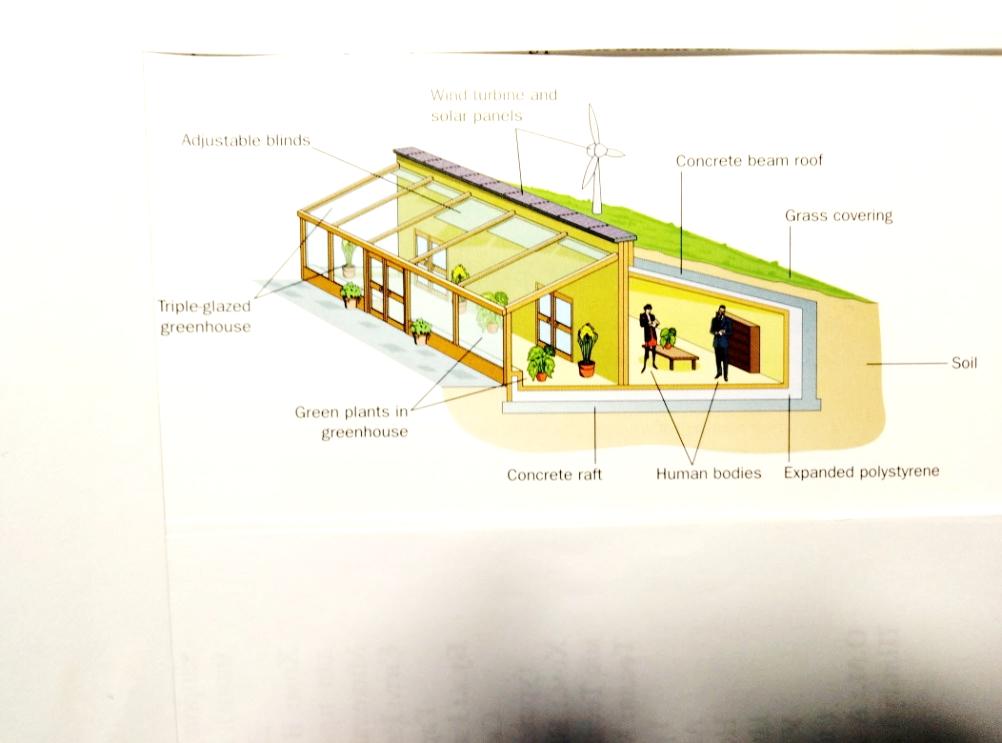
|
heat doesn’t escape, use too much power within the house, the temperature can be controlled, produce power to the house, provide insulation, receive the maximum amount of sun, save energy, purify the air, prevent the loss of heat, be kept dry |
As you see, there are several features in this house that have been designed to
(a)__________ but still provide a comfortable living area. On one side you can see a large glazed greenhouse that faces south so as to (b) ___________ . It is in fact triple glazed in order to (c) _______________. Inside this greenhouse, we would recommend plenty of green plants to (d) ___________. Of course it can get quite hot on summer days so adjustable blinds are fitted on all the glass windows so that (e) __________ . Wind turbines and solar panels are fitted to the roof in order to (f) ___________ . For the house to (g) ______________, the foundations consist of a concrete raft. The inner layer is made of expanded polystyrene which is used to (h)____________. The roof comprises concrete beams with a thick soil covering and grass so that (i) __________. Of course, there are also people in the house to generate a certain amount of heat too. In addition, so as not to (j) ____________, low energy equipment and lighting are used.
2. Put the following tasks into the appropriate phrase and constructions
Consulting engineer communications with client, extensive site investigation, consulting engineer contact with contractors, feasibility study, detailed design, maintenance, employment of consulting engineer, preliminary site investigation
|
Phrase |
Task |
|
Before construction |
|
|
During construction |
|
|
After construction |
3. Match the following words and phrases with their definitions
|
1. feasibility study |
a) building or installation which is built, supplied, or installed complete and ready to operate |
|
2. site investigation |
b) activities carried out after the project to ensure problems are solved |
|
3. maintenance |
c) detailed plan of proposed structures |
|
4. soil mechanics |
d) dimensions and measurements |
|
5. specifications |
e) extensive investigation to evaluate the load - bearing qualities and stability of the ground |
|
6. technical drawings |
f) іnvestigation to assess both financial and engineering aspects of a project |
|
7. commissions a project |
g) offer to a bid for an engineering contact |
|
8.costing system |
h) procedure to monitor the cost of a project so that management can get information on development |
|
9.tender |
i) study of proposed location to assess geology of the area |
|
10.turnkey projects |
j) to order a plan to be carried out |
Text 11
1. Read the introduction to the interview and choose the best answer.
How to be eco – friendly
These days, everyone knows it’s important to protect the environment and reduce their carbon footprint. But how often have you said “What I do doesn’t make a difference?”If everyone makes excuses like this, then no positive changes happen. Stuck for ideas about what to do? Read about Connal Barry and his family they’ve had some great ideas!
EcoLife: First of all, why did you decide to become more eco-friendly?
Connal: Well, my dad was always telling me to turn off the TV or computer – he complained about the cost of electricity! He kept saying it wasn’t good for the planet, either.¹______That’s when I realized that most energy sources are running out.
EcoLife: What did you do?
Connal:² _____to change their electricity supplier to a green supplier. Then the whole family – me, my parents, and my sister, Sarah – sat down to discuss what we could do at home to save energy.
EcoLife: And?
Connal: ³____ like not leaving the computer and TV on standby, using energy- saving light bulbs, turning the heating down and recycling more stuff… but then we decided that wasn’t enough.
EcoLife: What else did you do?
Connal: Well, first I said I would use the computer far an hour less each day, but I love computer games and chatting online so that was really difficult!4_____ I got up just half an hour earlier during the week and cycled to school instead of taking the bus. I got much fitter and I didn’t feel so bad about using the computer so much!
EcoLife: What about the rest of the family?
Connal: Last month, my dad used public transport to get to work, instead of driving. My mum switched your mobile off every afternoon – she found that difficult because she often texts her friends. My sister stopped using her hair – dryer.
EcoLife: And if everyone keeps their promise for a month, you do something fun together – is that right?
Connal: Yes,5 _________It was so cool.
EcoLife: And what’s your next energy – saving idea?
Connal: Next month, we’re going to have a gadget – free day every Thursday.
EcoLife: What’s that?
Connal: We don’t use any gadgets! You know, no computer, no TV, no mobile phone, no mp3 player, no microwave…
Ecolife: That sounds difficult!
Connal: 6____We’re going to play boards games – I’m learning chess. And we’re having a homework – help hour - my parents will help us with any problems. Oh, and if the weather’s good, we’re going to have a barbecue in the garden!
The text is about
a) What a typical teenager can do to protect the environment.
b) A family that tries to be environmentally – friendly.
2. Read the interview and match the missing phrases and sentences a-f to the correct place 1-6 in the text.
a We went on a trip in a hot – air balloon last month!
b Well, we did all the usual things,
c Well, first I persuaded my parents
d I looked on the internet to find out where electricity comes from.
e No, there’s loads to do!
f I broke my promise lot, so I tried something else.
3. Read the interview again. Tick (+) true or (-) false or (?) if there is no information.
1. Electricity in Britain is very expensive.
2. All the members of Connal’s family talked about ways to use less energy.
3. Each family member promised to do one thing every month to save energy.
4. Using the computer for an hour less every day saves a lot of energy.
5. Connal had to get up much earlier to cycle to school.
6. Next month, members of the family will only use one gadget, on Thursdays.
Text 12
1.Read the text and match the title to the each part of the text.
ECO – TOURISM
A. Building hotels and villas permanently affects the environment, that’s why many holiday companies are looking for alternatives. One possible answer is luxury ‘holiday pods’. You can assemble them anywhere in the world, from the South Pacific to the Sahara Desert, and they can remain in place for up to fifteen years. Then they can be packed up and moved to another location. The damage to the environment is almost zero: all the waste produced in the pods is collected and recycled. But some people don’t believe there’s anything particularly new in this. A travel writer Carl Jenkins has said, ‘Lots of people already have similar pods, they’re called caravans.’
B. Why not try a holiday on a helium – filled airship hotel? As we all know, air travel creates more carbon dioxides than any other form of travel but this revolutionary airship might change that. It will be able to travel for 3,100 miles without stopping, and combines the experience of travelling by cruise ship, hot air balloon and aeroplane. Yet it requires no fuel or runways. The engines use hydrogen and the airship travels at a lower speed and altitude than a normal plane, giving the passengers the opportunity to sightsee from above. As the designers say, ‘Passengers can see fantastic places without landing and buying a ticket’
C. A big trend for young people is ‘ecoteering’: a combination of voluntary work and environmentally – friendly holiday. Choices include replanting tropical forests in India, working as a jungle guide in remote parts of Cambodia, or working with endangered wild animals. According to student Laurence Ford, who spent two months working at a wolf sanctuary in New Mexico, USA, ‘The whole experience was awesome. I formed a real bond with the wolves and I loved waking up to the sound of their howling!’
Whatever you decide to do, I think the days of choosing a holiday without thinking about the environment will soon be over. Eco – tourism is growing three times faster than any kind of tourism!
1.Travelling by air without producing carbon dioxide.
2. The options for young people who care about environment but also but also want adventures.
3. To have luxury holidays in exotic places without damaging the environment.
2. Read the text again and choose the correct answer.
1. Holiday pods
a) cannot be moved from one place to another.
b) do not damage the environment.
c) have to stay in the same place for fifteen years.
d) are a way of recycling the waste that tourists produce.
2. Carl Jenkins thinks that holidays pods
a) are bad for the environment.
b) are not really a new idea.
c) will eventually replace caravans.
d) are a very original idea.
3. The airship hotels
a) need to stop often.
b) travel faster than aeroplanes.
c) produce a more eco – friendly way to sightsee.
d) will be cheaper than travelling by plane.
4. Ecoteering is
a) a good way of relaxing.
b) a way of attracting more tourists to remote places.
c) becoming more and more popular with young people.
d) a very dangerous.
5. Laurence Ford
a) enjoyed all aspects of his holiday.
b) couldn’t sleep because the wolves were so noisy.
c) went searching for wolves.
d) didn’t enjoy his visit to the wolf sanctuary.
3. Guessing meaning from context. Find a word in the text that means:
1…………different possibilities;
2…………completely new and different;
3…………how high something is;
4…………a change or fashion;
5…………far away from people and towns;
6…………in danger of becoming extinct;
7…………a safe place for animals or people who are in danger.
4. Discuss the questions in pairs.
1) What are the good and bad points about each of the eco-holidays described?
2) Which appeals to you most and which appeals the least? Why?
3) What is your ideal holiday?
5. Write a postcard. Imagine that you are on one of the holidays in the text. Include the information about:
. the place/the other people
. how you spend your time
. whether you are enjoying yourself.
Why? Why not?
Text 13
1. Read the text.
Progress in saving the planet.
Although over the last twenty years a great deal has been achieved in the protection and conservation of the environment, there is still an awful lot to do. According to some scientists, we have managed to reduce the amount of damage we are doing to the atmosphere, and the hole in the ozone layer is starting to close. Thanks to dedicated individuals, species of plants and animals life which have been threatened with extinction have now been saved. On the other hand, every day many species become extinct. Laws and regulations exist to stop factories polluting rivers and seas but this remains a major problem. And the use of cars means that we are still making our cities and towns unbearable to live in, despite the fact that progress has been made with public transport systems. So, while some problems have been solved already, we cannot afford to stop making an effort.
2. Complete the sentences.
1. A great deal has been achieved in ……………….
2. Every day ……………………………………….
3. There is still an awful …………………………….
4. Progress has been made ………………………….
5. We are still making our cities and towns …………
6. Laws and regulations exist to stop………………..
7. Thanks to dedicated individuals, …………………
3. Use a word from the box in each gap to complete the sentences.
|
protesting, pollution, leaking, dam, evaporation, drought |
1…………..pipes are responsible for the loss of thousands of tones of water every day.
2. There are plans to build a ………… to stop the flow of the river and collect water in reservoir.
3. ………….. from factories is one of the biggest problems facing our rivers and seas.
4. The recent ……….. in our country meant that there was not enough water and we all had to be very careful how much we used.
5. We should start ………. against the trees being cut down in nearby forest.
6. …………….. is when water disappears into the atmosphere.
4. Use the correct passive tense to rewrite these sentences.
1.The cold weather has killed almost all the birds on the island.(active voice)
Almost all the birds on the island have been killed by the cold weather. (passive voice)
2. We are encouraging people not to drop litter.
________________________________________________________
3. The local people have prevented the government from building a new reservoir.
_________________________________________________________
4. Yesterday, they announced some dramatic news about the environment.
__________________________________________________________
5. Match the beginnings 1 – 6 with the endings a – f to make collocations.
|
1. sewerage |
a) effect |
|
2. endangered |
b) reserve |
|
3. greenhouse |
c) species |
|
4. global |
d) warming |
|
5. nature |
e) fuels |
|
6. fossil |
f) system |
Text 14
1. Read the text below and complete each gaps with one world from the box which best fits.
|
Order, to/for, of, have, than, example, out, in, as, around/over, to, at, |
Eco Projects
Schools all (1)……… the world are becoming actively involved in environmentally friendly programmes and projects. Many (2)……… the projects concern recycling paper and other waste regularly. This helps conserve and protect our natural resources. The projects leaders encourage their students (3) ……….. adopt these habits (4) ……… home and in their communities, spreading awareness of the need to recycle.
Other schools (5) ……… gone beyond these traditional measures and are developing more ambitious eco projects. These take many forms and try to raise students’ awareness of environmental issues in novel ways. For (6) ………… , recreational areas constructed entirely (7) ………… of recycled resources are becoming increasingly common. Other projects involve ecological art programmes, (8) …………. Which students make work of art such (9) ……….. sculptures from previously used materials. These are not only beautiful, but also make a statement about how much of what we consume could actually be used again.
All in all, young people today are more aware (10) ……….. ever of the world’s dwindling natural resources. They are conscious that they are growing up in a world where environmental can no longer be ignored. With the help of their schools, many of them are working together in (11) ……… to find bright new solutions (12) ………. old problems.
2. Work in the pairs. Use the questionnaire ‘How green are you?’ below to interview your partner.
Which of these things do you do?
1. Turn the lights off when you leave the room.
2. Walk or cycle to school every day.
3. Leave the TV or hi – fi standby.
4. Use a re-usable bag when you go shopping.
5. Use both sides of a piece of paper.
6. Drop litter when you are out with your friends.
7. Collect and recycle cans and plastic bottles.
3. Check your answers. Tell the class about your partner.
1. +2 points, because leaving lights on wastes a lot of electricity.
2. +5 points, because many short cars journeys are unnecessary and create more pollution and greenhouse gases than long journeys.
3. -2 points, because leaving machines on standby increases our electricity use by about 7 - 10
4. +3 points, because over 500 billion plastic bags are used and thrown away every year.
5. +2 points, because 40 of all the trees cut down are used to make paper.
6. – 8 points, because litter looks horrible, costs a lot of money to clean up and is bad for wildlife.
7. +5 points, because recycling saves energy and resources .It also reduces the amount of rubbish we produce which has to be put somewhere.
Results:
6 or under: you are a disaster for the planet!
Over 6: that’s quite good but you can do more!
Over 10: brilliant, you are a good green!
4. Read the text again and answer the following questions.
1. How important the environment for you?
2. What do you think is the biggest environmental problem (in the world or your area)?
3. How will the global warming affect our lives?
4. What do you do to help the planet?
5 .Choose the words a –c that can complete each phrase 1 – 6. There are two correct answers for each.
- waste___________________
- energy b) fuel c) the environment
- recycle___________________
- pollution b) waste c) glass
- switch on/off _______________
- the computer b)fuel c) the lights
- protect ____________________
- wildlife b)the environment c) energy
- reduce ________________________
- pollution b)carbon emissions c) the heating
Text 15
1.Read the text below. Match choices (A-F) to (1-5). There is one choice you don’t need to use.
Ideas for environmental learning projects
Are you looking an idea for the next science fair or a class project? We have a collection of project ideas that cover a number of issues relating to the natural environment.
1.____________________________________________
'Green electricity' is power produced from sources that do not harm the environment. Green power production technologies are those that that clearly reduce the harmful environmental impacts of energy generation. They generally make use of renewable sources like wind, water, sun and biomass.
Wind Energy is energy harnessed from the wind. Man has used wind energy for over 2000 years. In many places, wind energy was harnessed by windmills for pumping water and grinding grain. Windmills work by slowing down the speed of the wind. The wind flows over the blades causing them to turn.
The blades are connected to a drive shaft that turns an electric generator to produce electricity.
2._______________________________________
Rainwater harvesting refers to the collecting of rainwater, mostly on a roof, from where it flows through gutters into a collection tank. In other words, it refers to a storage system-could be either above or below the ground-that collects, stores and distributes run-off of rain or snow from roofs.
Rainwater harvesting can provide clean water-supply for a small community. Especially when pipelines are too expensive to set up and one central well or pump cannot be used all around the year, a rainwater catchment system is a workable solution.
3.______________________________________________________
Energy saved is energy produced. This is not just a physics fact, but a crucial detail to remember while speaking of conservation. Most of the power generated in the world today comes from fossil fuels. Even though increasing numbers are shifting to 'green electricity', the production of electricity remains one of the most polluting activities of humankind.
However, the good news is that a little bit of conscientious saving and some commonsense can go a lot way in cutting down on power demands drastically. Not only does that reduce the pressure on energy production and subsequently pollution, it could slash our household electricity bills by as much as half!
4.________________________________________________________
Greywater is wastewater from any household source other than toilets. Greywater makes up roughly 60% of household wastewater. A greywater recycling system uses water primarily from showers and bathtubs. It can also capture water from bathroom or wastewater from the utility sink and washing machine.
Wastewater that includes toilet waste is called black water. Because it contains fecal matter, black water is not safe for domestic recycling under any circumstances.
5._______________________________________________________________
Nature has given us excellent means of cooling our surroundings naturally. Trees give shade and keep us cool. Ever wondered why the open areas such as playing fields, football grounds and other open areas seem hotter during the day?
In contrast the breeze that flows from trees feels so cool. These are our natural air conditioners. Much of the cost of cooling at home can be saved by passive cooling techniques that are inexpensive and can be set up easily. We can do this with good insulation, using trees for shade, and drawing curtains to keep off the heat.
A Save energy: Create your own natural cooling system.
B. Energy Conservation
C. Rainwater Harvesting
D. Green Power
E. Recycling greywater for gardening
F. Organic Garden
2. Choose the correct word or phrase to complete the sentences.
1. After seven years in the city, he had had enough of rural/urban life.
2. One modern problem facing many of us is that of fog/smog.
3. Companies are being forced to bring out/take out green products if they want to keep their customers satisfied.
4. We are rapidly going out of /running out of fossil fuels.
5. There are very few poisonous/poisoned shakes in the wild in this country.
6. Industrial/Occupational pollution is reaching dramatic levels in certain parts of the world.
3. Put the word in the correct order to make sentences.
1)harvesting, can, for, a small, water-supply, provide, community, rainwater, clean.
2) nature, has, us, cooling, surroundings, given, naturally, excellent, our, means, of.
3) black, wastewater, is, includes, waste, called, water, toilet, that.
4)the, flows, blades, the, wind, them, over, causing ,to, turn.
5) contrast ,trees, flows, breeze, in, from, feels, that, so, the, cool.
4. Match the words 1-7 with a-g to make collocations.
|
1. recycling |
a) generator |
|
2. black |
b) number |
|
3. good |
c) system |
|
4. increasing |
d) electricity |
|
5. small |
e) water |
|
6. electric |
f) insulation |
|
7. green |
g) community |
5. Complete the each sentence with one world from the box .There are some words you don’t need to use.
|
carbon , jam, global, crowded, recycling, dioxide, wasting, destroying |
1.There is little doubt that___________warming is happening.
2.Greenhouse gases from cars factories and power plants are_________ our environment.
3.Planes produce far more _________ dioxide (CO2) than any other form of transport.
4.There are many ways to protect the environment. One of them is to _________ paper, glass and plastic.
5. Large vehicle with big engines produce a lot of carbon______________.
Text 16
1. Read the text.
How to Reduce Your Electricity Consumption
Did you know, your TV could consume up to 25 per cent of its total power requirement when on standby? Or that 85 per cent of the electricity consumed by your VCR is when it is not running? Or if every home in the UK used three compact fluorescent lamps (CFLs), it would save enough power to supply all street lighting in the UK for a year?
Startling facts indeed. It does not take much to start cutting down on our electricity demands. If you make an effort through a few simple changes in your lifestyle, you will be surprised at the amount of money you could save.
Listed below are a few suggestions to get you going:
- When buying appliances, look for energy efficiency.
- Reducing your thermostat by 1 degree Celsius can cut down your electricity bills by 10 per cent.
- Running a maximum-load wash in your washing machine is more efficient than two half-loads.
- Use compact fluorescent lamps (CFLs) instead of ordinary light bulbs. They use a fraction of the power and last up to 10 times longer. If each household in the UK used three CFLs, it would save enough electricity to supply all street lighting in the UK for a year.
- Turn off computers when not in use.
2.Match the verbs 1-7 with the nouns/expressions a - h
|
1. save |
a) pollution |
|
2. turn |
b) the environment |
|
3. fall |
c) out with your sister |
|
4. destroy |
d) the central heating down |
|
5. pick |
e) fuel |
|
6. reduce |
f) in touch |
|
7. keep |
g) somebody up |
3. Underline the correct word to complete the sentences.
1. There are many ways to save/reduce pollution.
2. Could you turn down/switch off the heating a bit? It’s really hot in here.
3. Do you think tourism is destroying/wasting the environment?
4. More and more people nowadays recycle/save paper, glass and plastic.
5. Could you turn down/switch off the computer? You are not using it at the moment.
6. You are wasting/destroying a lot of energy by leaving the television on standby.
4. Write down 10 verbs from the text and make Past Indefinite and Past Participle forms.
For example: consume - consumed – consumed;
5. Complete the sentences.
1.________________look for energy efficiency.
2. If every home in the UK used three compact fluorescent lamps , _________
3. It does not ____________________ our electricity demands.
4._______________ in your washing machine is___________________.
5. ___________you will be surprised at the amount of money you could save.
Text 17
1.Read the text.
Waste Management: Evaluate How You Can Reduce Packaging Waste in Your Home
We have always been told that it is what's inside that counts. But when it comes to conservation, packaging deserves more attention than most of us would think. While packaging performs the key functions of protecting a product and providing information for buyers, what we tend not to think about is what happens to it later. Why, it has to be disposed of, of course.
Most packaging is made out of paper, plastic, glass, aluminium, steel and fibreboard. Just food packaging itself is a massive global business. When it comes to disposal, most packaging is not recycled, but dumped in landfills or burnt. This results in pollution in a number of ways. And, of course, we are not even counting the pollution caused by the manufacture and transportation of packaging in the first place.
What you can do.
There are a number of things you can do to minimize packaging waste. By doing so, you will be reducing demand on resources needed for its disposal and also the pollution caused as a result. Reusing and recycling packaging products, like paper and plastic bags, string and wrapping paper, are, of course, obvious options. Take a look around you and try to figure out what other ways there are to manage packaging waste. Here are a few hints:
- Buy in bulk. Buying lots of smaller packs generates more waste. Bulk purchasing saves money, too.
- Always carry your own bags while shopping.
- Try to buy loose products where available. For instance, in case of vegetables and fruits.
- Opt for brands that have less packaging.
- Avoid buying bottled water unless tap water in your area is unsafe for drinking.
2. Read the text again. Tick (+) true, (-) false or write (?) if there is no information.
1. Most packaging is made out of paper, plastic, glass, aluminium, steel and fibreboard.
2. There are not a number of things you can do to minimize packaging waste.
3. Avoid buying bottled water unless tap water in your area is safe for drinking.
4. Reusing and recycling packaging products, like paper and plastic bags, string and wrapping paper, are, of course, obvious options.
5. We tend not to think about is what happens to packaging later.
3. Match the words 1-4 with their opposites a-d.
|
1. positive |
a) happy |
|
2. miserable |
b) weakness |
|
3. mental |
c) negative |
|
4. strength |
d) physical |
4. Use a word from the box in each gap to complete the sentences.
|
being, been, be, are, was, have |
1. After last month’s fire, huge areas of forests _______been destroyed.
2. Many old cars, fridges and cookers ________simply dumped at the side of the road every year.
3. The situation regarding the polluted lake is ______ investigated by scientists.
4. The results of the study of insects will ______ released next month.
5. Government officials have ________ criticized for their plans to build the airport in the area of natural beauty.
6. A new law __________ introduced yesterday banning the use of a range chemicals in industry.
5. Make the adjectives from the box negative by adding the prefixes un- or in-
|
ambitious, decisive, formal, happy, sensitive, successful, tidy |
For example: ambitious – unambitious
ДЛЯ НОТАТОК
__________________________________________________________________________________________________________________________________________________________________________________________________________________________________________________________________________________________________________________________________________________________________________________________________________________________________________________________________________________________________________________________________________________________________________________________________________________________________________________________________________________________________________________________________________________________________________________________________________________________________________________________________________________________________________________________________________________________________________________________________________________________________________________________________________________________________________________________________________________________________________________________________________________________________________________________________________________________________________________________________________________________________________________________________________________________________________________________________________________________________________________________________________________________________________________________________________________________________________________________________________________________________________________________________________________________________________________________________________________________________________________________________________________________________________________________________________________________________________________________________________________________________________________________________________________________________________________________________________________________________________________________________________________________________________________________________________________________________________________________________________________________________________________________________________________________________________________________________________________________________________________________________________________________________________________________________________________________________________________________________________________________________________________________________________________________________________________________________________________________________________________________________________________________________________________________________________________________________________________________________________________
ДЛЯ НОТАТОК
_________________________________________________________________________________________________________________________________________________________________________________________________________________________________________________________________________________________________________________________________________________________________________________________________________________________________________________________________________________________________________________________________________________________________________________________________________________________________________________________________________________________________________________________________________________________________________________________________________________________________________________________________________________________________________________________________________________________________________________________________________________________________________________________________________________________________________________________________________________________________________________________________________________________________________________________________________________________________________________________________________________________________________________________________________________________________________________________________________________________________________________________________________________________________________________________________________________________________________________________________________________________________________________________________________________________________________________________________________________________________________________________________________________________________________________________________________________________________________________________________________________________________________________________________________________________________________________________________________________________________________________________________________________________________________________________________________________________________________________________________________________________________________________________________________________________________________________________________________________________________________________________________________________________________________________________________________________________________________________________
ДЛЯ НОТАТОК
____________________________________________________________________________________________________________________________________________________________________________________________________________________________________________________________________________________________________________________________________________________________________________________________________________________________________________________________________________________________________________________________________________________________________________________________________________________________________________________________________________________________________________________________________________________________________________________________________________________________________________________________________________________________________________________________________________________________________________________________________________________________________________________________________________________________________________________________________________________________________________________________________________________________________________________________________________________________________________________________________________________________________________________________________________________________________________________________________________________________________________________________________________________________________________________________________________________________________________________________________________________________________________________________________________________________________________________________________________________________________________________________________________________________________________________________________________________________________________________________________________________________________________________________________________________________________________________________________________________________________________________________________________________________________________________________________________________________________________________________________________________________________________________________________________________________________________________________________________________________________________________________________________________________________________________
ДЛЯ НОТАТОК
________________________________________________________________________________________________________________________________________________________________________________________________________________________________________________________________________________________________________________________________________________________________________________________________________________________________________________________________________________________________________________________________________________________________________________________________________________________________________________________________________________________________________________________________________________________________________________________________________________________________________________________________________________________________________________________________________________________________________________________________________________________________________________________________________________________________________________________________________________________________________________________________________________________________________________________________________________________________________________________________________________________________________________________________________________________________________________________________________________________________________________________________________________________________________________________________________________________________________________________________________________________________________________________________________________________________________________________________________________________________________________________________________________________________________________________________________________________________________________________________________________________________________________________________________________________________________________________________________________________________________________________________________________________________________________________________________________________________________________________________________________________________________________________________________________________________________________________________________________________________________________________________________________